Posts

Nursing homes in Spain at a glance

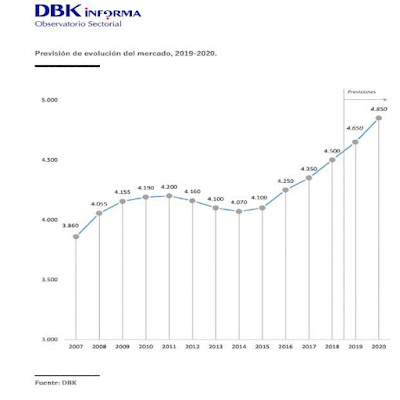
Although it is very difficult to know exactly how many nursing homes there are in Spain because the statistics are made from the regions.  There is no doubt that it is a growing sector that in ten years (from 2008 to 2018), went from a turnover of 4,055 to 4,500 million euros and would have reached 4,800 in 2020 if it had not been for the pandemic. Thus, according to public data, in 2019 there were 372,985 places in Spain (in 5,417 nursing homes).   This is to serve a population over 65 years of age of about nine million people, which means a little more than 4 beds for every 100 people over 65 years of age. If the 5 beds per 100 elderly people recommended by the experts are to be reached, Spain will need to build 70,000 nursing homes in the coming years. The private nursing home sector is undergoing a process of concentration and the arrival of foreign capital. The large groups are the result of the merger of several companies. For instance, Domus Vi is made up of two la...
Who is who in the Spanish nursing home industry

Image
Care home industry in Spain is in continuous growth and in a trend towards concentration and internationalisation. This is the line of evolution of the number of nursing homes in Spain according to the DBK consultancy, which has been publishing sector reports for years. This is the top 10 of the companies and entities that manage long term care homes in Spain according to the prestigious magazine Alimarket Sanidad y Dependencia.  To find out much more about them, it is worth subscribing to the magazine https://www.alimarket.es/sanidad. A care home has two clear aspects, on the one hand there is the property and on the other the management company. In the real estate field, Healthcare Activos, which already owns 17 geriatric assets in operation and another six in the pipeline, has continued to develop its growth strategy in the sector. Specifically, in September 2019, the company transferred all its assets to the new company Healthcare Activos Yield, in which a group of investors gr...

The future of Spanish nursing homes. Doubts and opportunities

Image
The global pandemic of covid-19 is leaving a large number of people affected. Due to its characteristics, the most affected population, with a high mortality rate, is the elderly (according to data from the Spanish Ministry of Health, 80% of those who died from the virus were over 70 years of age). This circumstance and the particular situations of each nursing home, which must be analysed with rigour and caution (safety conditions, late reactions, etc.), have led to a reflection on the care and business model for the care of the elderly who require a residential solution. Of the 5457 centres, 1394 are publicly owned, regardless of management, and 4063 are privately owned. The national average shows the following balance: 74.4% of the homes for the elderly in Spain are privately owned, with an average of 69.8 places per home. Of the total number of places (59.8%) are publicly funded and the rest (40.2%) are privately funded. According to data from the Institute for the Elderly and Soci...

How much do people working in care homes in Spain earn?

Image
Labour relations in Spain are usually regulated through collective bargaining agreements, which means that trade unions and employers' associations agree on the working conditions of a given sector. In the case of nursing homes in Spain, there is a VII Collective Agreement on Dependency which is in force until the next one is negotiated. According to the collective agreement, people working in nursing homes in Spain work a total of 1,792 hours per year according to a work schedule that also has to meet the requirements of the agreement. Although the collective agreement is, in principle, for all care homes in Spain, it is true that some regions have their own collective agreement.  This is the case of Valencia, Galicia or the Basque Country. If someone wants to buy or build a nursing home in Spain, he or she should check whether the area where it is to be set up has its own collective agreement. The collective agreement also sets the salary and working conditions. These are the sa...

How many people work in a nursing home in Spain

A nursing home is basically an adapted building, a team of professionals and a way of working that supports the residents with quality and respect.  The care home offers 24-hour hotel service, help with activities of daily living, personal support and a certain degree of medical care. The team of professionals is therefore a key element. For many people who have a relative living in a nursing home, the feeling is that there is never enough staff.  But, how many people usually work in a care home? The regulations affecting nursing homes are regional (Comunidad Autónoma), so there is no national law that applies to the whole of Spain. The regional regulations require staff ratios of between 0.30 and 0.50, i.e. one full-time worker for every two or three residents.  As the residences are services that are open 24 hours a day every day, this staff has to be distributed so that, in the end, the number of carers present is lower.  In addition, along with the "visible" staf...

How many elderly people live in nursing homes in Spain?

Image
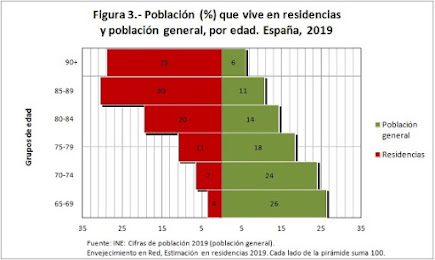
Eventhough news outlets and social networks publish data about the number of nursing homes and people living in them, as of March 2021 there are no reliable statistics on the population who live in care homes in Spain.  There are some data that describes different dwellings where older people live but they don’t refer exactly to nursing homes. During 2020 the Covid-19  health emergency led to a high number of deaths among the elderly, specially those living in care homes. This terrible event has highlighted the scarce and scattered information and the general lack of knowledge about life in care homes, very close to a general social, political and health neglect, which has unnecessarily damaged the image and the good work of most of these institutions and the staff who work in them. Envejecimientoenred, a web site that deals with elder statistics, tried to fill the gap publishing a report in mid 2020.  They estimated that on average 322,180 people aged 65 and over live i...

A feasibility study is paramount before investing in a nursing home in Spain

Image
  In recent years,  Eai Consultoría  has established itself as a recognized knowledge manager within the gero-care sector. Dependencia.info spoke  with  Xavier Paradell  , a consultant from the firm specialized among other areas in the preparation of market studies and economic-financial viability in the field of nursing homes in Spain, who makes it clear that "a feasibility study allows the promoter of a residence to know the factors that will guarantee the project". Is it common for promoters of a care home project to request a market study and economic and financial feasibility study? My impression is that it is less common than it should be, considering its strategic relevance, since a market study allows the promoter  to know the main key factors that will facilitate the viability of the project. Those can be very different in each particular case. Having a market study and economic and financial feasibility study prepared by specialists is paramo...