ESADE Bussiness School Alumni association recently organized a webinar about investment opportunities in the Spanish nursing home industry. The environment in which this event has taken place is one in which the population over 65 years of age has increased by one million in the last decade. In this time, the global capacity of long term care facilities for the elder has only increased by 12.353. These are public data recently published by the Imserso (Spanish Institute of ageing and social services). If the right ratio for nursing home beds for 100 people over 65 is 5% , in Spain the ratio is 4.21. Nine years ago it was 4.56. To comply with the benchmark, Spain should increase the number of nursing home beds by 70.000 places, 18.4% more than the current 381,158. The president of Healthcare Activos, a firm specialized in long term care investment and health real estate assets, proposed the reordering the nursing home sector in the face of the Covid-19 health crisis. Accordig...
Posts
HOW HAS THE CARE FOR THE ELDER INDUSTRY EVOLVED IN SPAIN?
- Get link
- X
- Other Apps
In 2010 , Pricewater House Coopers wrote a report about the Long Term Care industry and care for the elderly in Spain. Eventhough some years have gone by, it is interesting to read the report and think about how have things changed. These are the conclusion of the report: The Law on Promotion of Personal Autonomy and Care for Dependent People, known as Ley de dependencia (Law 39/2006, of December 14) commits the government to assisting all those individuals in a situation of dependency, most of whom are elderly. The review of data regarding the elderly population and the design of the theoretical cost model carried out in the preceding sections are not intended to be exhaustive but are useful for contemplating important issues regarding the situation of the care home sector in Spain. 1. The remaining authorisations of long-term care service providers need to be completed. This is essential to guarantee Spanish people an equitable right to care services of comparable quality ...
Some data about Spanish elderly population and nursing homes
- Get link
- X
- Other Apps
One of the greatest XX century achievement has been the increase in life expectancy of mankind, specially people living in Spain and other western countries, brought about by, among other factors, the improved public health and welfare conditions. Over the last 45 years, Spanish development model has enabled an increase in the number of people reaching old age and doing so in a situation of relative financial stability. However, the increase in life expectancy coupled with a significant drop in the birth rate over the last 30 years has led to a rapid transition to an ageing population. At this time it is estimated that in the European Union there are only two people of working age for each adult of 65 years or more. However, the challenge and scope of ageing populations varies for each of the member countries. Spain stands out as one of the countries where it is most prominent, reaching rates of around 32% in 2050, only exceeded by Italy and Slovenia. According to demographic fore...
Nursing homes in Spain at a glance
- Get link
- X
- Other Apps
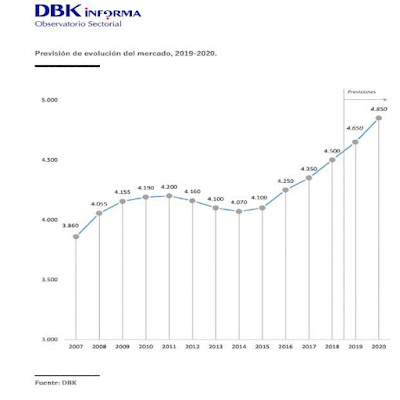
Although it is very difficult to know exactly how many nursing homes there are in Spain because the statistics are made from the regions. There is no doubt that it is a growing sector that in ten years (from 2008 to 2018), went from a turnover of 4,055 to 4,500 million euros and would have reached 4,800 in 2020 if it had not been for the pandemic. Thus, according to public data, in 2019 there were 372,985 places in Spain (in 5,417 nursing homes). This is to serve a population over 65 years of age of about nine million people, which means a little more than 4 beds for every 100 people over 65 years of age. If the 5 beds per 100 elderly people recommended by the experts are to be reached, Spain will need to build 70,000 nursing homes in the coming years. The private nursing home sector is undergoing a process of concentration and the arrival of foreign capital. The large groups are the result of the merger of several companies. For instance, Domus Vi is made up of two la...
Who is who in the Spanish nursing home industry
- Get link
- X
- Other Apps
Care home industry in Spain is in continuous growth and in a trend towards concentration and internationalisation. This is the line of evolution of the number of nursing homes in Spain according to the DBK consultancy, which has been publishing sector reports for years. This is the top 10 of the companies and entities that manage long term care homes in Spain according to the prestigious magazine Alimarket Sanidad y Dependencia. To find out much more about them, it is worth subscribing to the magazine https://www.alimarket.es/sanidad. A care home has two clear aspects, on the one hand there is the property and on the other the management company. In the real estate field, Healthcare Activos, which already owns 17 geriatric assets in operation and another six in the pipeline, has continued to develop its growth strategy in the sector. Specifically, in September 2019, the company transferred all its assets to the new company Healthcare Activos Yield, in which a group of investors gr...
The future of Spanish nursing homes. Doubts and opportunities
- Get link
- X
- Other Apps
The global pandemic of covid-19 is leaving a large number of people affected. Due to its characteristics, the most affected population, with a high mortality rate, is the elderly (according to data from the Spanish Ministry of Health, 80% of those who died from the virus were over 70 years of age). This circumstance and the particular situations of each nursing home, which must be analysed with rigour and caution (safety conditions, late reactions, etc.), have led to a reflection on the care and business model for the care of the elderly who require a residential solution. Of the 5457 centres, 1394 are publicly owned, regardless of management, and 4063 are privately owned. The national average shows the following balance: 74.4% of the homes for the elderly in Spain are privately owned, with an average of 69.8 places per home. Of the total number of places (59.8%) are publicly funded and the rest (40.2%) are privately funded. According to data from the Institute for the Elderly and Soci...
How much do people working in care homes in Spain earn?
- Get link
- X
- Other Apps
Labour relations in Spain are usually regulated through collective bargaining agreements, which means that trade unions and employers' associations agree on the working conditions of a given sector. In the case of nursing homes in Spain, there is a VII Collective Agreement on Dependency which is in force until the next one is negotiated. According to the collective agreement, people working in nursing homes in Spain work a total of 1,792 hours per year according to a work schedule that also has to meet the requirements of the agreement. Although the collective agreement is, in principle, for all care homes in Spain, it is true that some regions have their own collective agreement. This is the case of Valencia, Galicia or the Basque Country. If someone wants to buy or build a nursing home in Spain, he or she should check whether the area where it is to be set up has its own collective agreement. The collective agreement also sets the salary and working conditions. These are the sa...