Posts

Innovation and Nursing Homes

  After the emergence of the SAR-Cov2, a lot of people is talking about the approach to the change of model of the nursing homes for dependent elderly people, even more a lot of people who don’t know the reality of social services are giving opinions on this theme, digressing and proposing measures that are far from models of equity in our society. Although there are different interpretations and validity of the proposals, there is a consensus of all that the model should change ant the direct attentions to the users must be improved. The evolution trend of our populations pyramid is known to all, in which there will be an increasing number of people over to 65 years, and therefore a greater number of dependent people, who require specialized care. Face to this situation, any action must be considered taking into account demographic evolution (due to the increase in older people both in absolute and relative value) and above all taking into account economic stability. So we start f...

The Spanish Law on Dependency (Ley de Dependencia)

One of the greatest XX century achievement has been the increase in life expectancy of mankind, specially people living in Spain and other western countries, brought about by, among other factors, the improved public health and welfare conditions. Over the last 45 years, Spanish development model has enabled an increase in the number of people reaching old age and doing so in a situation of relative financial stability. However, the increase in life expectancy coupled with a significant drop in the birth rate over the last 30 years has led to a rapid transition to an ageing population.  At this time it is estimated that in the European Union there are only two people of working age for each adult of 65 years or more. However, the challenge and scope of ageing populations varies for each of the member countries. Spain stands out as one of the countries where it is most prominent, reaching rates of around 32% in 2050, only exceeded by Italy and Slovenia. According to demographic fore...

Innovation & Nursing homes

  After the emergence of the SAR-Cov2, a lot of people is talking about the approach to the change of model of the nursing homes for dependent elderly people, even more a lot of people who don’t know the reality of social services are giving opinions on this theme, digressing and proposing measures that are far from models of equity in our society. Although there are different interpretations and validity of the proposals, there is a consensus of all that the model should change ant the direct attentions to the users must be improved. The evolution trend of our populations pyramid is known to all, in which there will be an increasing number of people over to 65 years, and therefore a greater number of dependent people, who require specialized care. Face to this situation, any action must be considered taking into account demographic evolution (due to the increase in older people both in absolute and relative value) and above all taking into account economic stability. So we start f...
Image
ESADE Bussiness School Alumni association recently organized a webinar about investment opportunities in the Spanish nursing home industry. The environment in which this event has taken place is one in which the population over 65 years of age has increased by one million in the last decade. In this time, the global capacity of long term care facilities for the elder has only increased by 12.353. These are public data recently published by the Imserso (Spanish Institute of ageing  and social services).  If the right ratio for nursing home beds for 100 people over 65 is 5% , in Spain the ratio is 4.21. Nine years ago it was 4.56. To comply with the benchmark, Spain should increase the number of nursing home beds by 70.000 places, 18.4% more than the current 381,158. The president of Healthcare Activos, a firm specialized in long term care investment and health real estate assets, proposed the reordering the nursing home sector in the face of the Covid-19 health crisis. Accordig...

HOW HAS THE CARE FOR THE ELDER INDUSTRY EVOLVED IN SPAIN?

In 2010 , Pricewater House Coopers wrote a  report about the Long Term Care industry and care for the elderly in Spain. Eventhough some years have gone by, it is interesting to read the report and think about how have things changed. These are the conclusion of the report: The Law on Promotion of Personal Autonomy and Care for Dependent People, known as Ley de dependencia (Law 39/2006, of December 14) commits the government to assisting all those individuals in a situation of dependency, most of whom are elderly. The review of data regarding the elderly population and the design of the theoretical cost model carried out in the preceding sections are not intended to be exhaustive but are useful for contemplating important issues regarding the situation of the care home sector in Spain.  1. The remaining authorisations of long-term care service providers need to be completed. This is essential to guarantee Spanish people an equitable right to care services of comparable quality ...

Some data about Spanish elderly population and nursing homes

One of the greatest XX century achievement has been the increase in life expectancy of mankind, specially people living in Spain and other western countries, brought about by, among other factors, the improved public health and welfare conditions. Over the last 45 years, Spanish development model has enabled an increase in the number of people reaching old age and doing so in a situation of relative financial stability. However, the increase in life expectancy coupled with a significant drop in the birth rate over the last 30 years has led to a rapid transition to an ageing population.  At this time it is estimated that in the European Union there are only two people of working age for each adult of 65 years or more. However, the challenge and scope of ageing populations varies for each of the member countries. Spain stands out as one of the countries where it is most prominent, reaching rates of around 32% in 2050, only exceeded by Italy and Slovenia. According to demographic fore...

Nursing homes in Spain at a glance

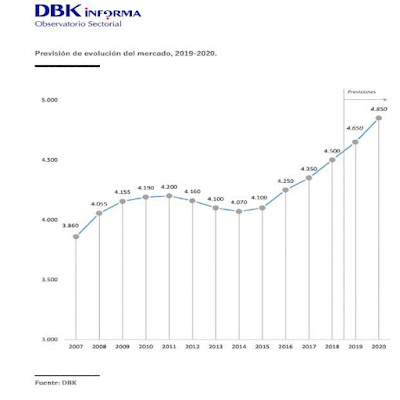
Although it is very difficult to know exactly how many nursing homes there are in Spain because the statistics are made from the regions.  There is no doubt that it is a growing sector that in ten years (from 2008 to 2018), went from a turnover of 4,055 to 4,500 million euros and would have reached 4,800 in 2020 if it had not been for the pandemic. Thus, according to public data, in 2019 there were 372,985 places in Spain (in 5,417 nursing homes).   This is to serve a population over 65 years of age of about nine million people, which means a little more than 4 beds for every 100 people over 65 years of age. If the 5 beds per 100 elderly people recommended by the experts are to be reached, Spain will need to build 70,000 nursing homes in the coming years. The private nursing home sector is undergoing a process of concentration and the arrival of foreign capital. The large groups are the result of the merger of several companies. For instance, Domus Vi is made up of two la...

Who is who in the Spanish nursing home industry

Image
Care home industry in Spain is in continuous growth and in a trend towards concentration and internationalisation. This is the line of evolution of the number of nursing homes in Spain according to the DBK consultancy, which has been publishing sector reports for years. This is the top 10 of the companies and entities that manage long term care homes in Spain according to the prestigious magazine Alimarket Sanidad y Dependencia.  To find out much more about them, it is worth subscribing to the magazine https://www.alimarket.es/sanidad. A care home has two clear aspects, on the one hand there is the property and on the other the management company. In the real estate field, Healthcare Activos, which already owns 17 geriatric assets in operation and another six in the pipeline, has continued to develop its growth strategy in the sector. Specifically, in September 2019, the company transferred all its assets to the new company Healthcare Activos Yield, in which a group of investors gr...

The future of Spanish nursing homes. Doubts and opportunities

Image
The global pandemic of covid-19 is leaving a large number of people affected. Due to its characteristics, the most affected population, with a high mortality rate, is the elderly (according to data from the Spanish Ministry of Health, 80% of those who died from the virus were over 70 years of age). This circumstance and the particular situations of each nursing home, which must be analysed with rigour and caution (safety conditions, late reactions, etc.), have led to a reflection on the care and business model for the care of the elderly who require a residential solution. Of the 5457 centres, 1394 are publicly owned, regardless of management, and 4063 are privately owned. The national average shows the following balance: 74.4% of the homes for the elderly in Spain are privately owned, with an average of 69.8 places per home. Of the total number of places (59.8%) are publicly funded and the rest (40.2%) are privately funded. According to data from the Institute for the Elderly and Soci...

How much do people working in care homes in Spain earn?

Image
Labour relations in Spain are usually regulated through collective bargaining agreements, which means that trade unions and employers' associations agree on the working conditions of a given sector. In the case of nursing homes in Spain, there is a VII Collective Agreement on Dependency which is in force until the next one is negotiated. According to the collective agreement, people working in nursing homes in Spain work a total of 1,792 hours per year according to a work schedule that also has to meet the requirements of the agreement. Although the collective agreement is, in principle, for all care homes in Spain, it is true that some regions have their own collective agreement.  This is the case of Valencia, Galicia or the Basque Country. If someone wants to buy or build a nursing home in Spain, he or she should check whether the area where it is to be set up has its own collective agreement. The collective agreement also sets the salary and working conditions. These are the sa...

How many people work in a nursing home in Spain

A nursing home is basically an adapted building, a team of professionals and a way of working that supports the residents with quality and respect.  The care home offers 24-hour hotel service, help with activities of daily living, personal support and a certain degree of medical care. The team of professionals is therefore a key element. For many people who have a relative living in a nursing home, the feeling is that there is never enough staff.  But, how many people usually work in a care home? The regulations affecting nursing homes are regional (Comunidad Autónoma), so there is no national law that applies to the whole of Spain. The regional regulations require staff ratios of between 0.30 and 0.50, i.e. one full-time worker for every two or three residents.  As the residences are services that are open 24 hours a day every day, this staff has to be distributed so that, in the end, the number of carers present is lower.  In addition, along with the "visible" staf...

How many elderly people live in nursing homes in Spain?

Image
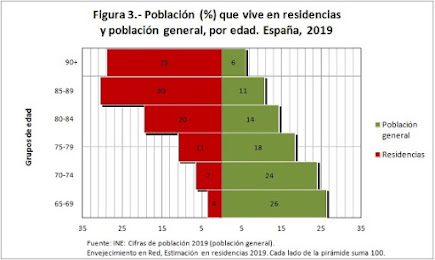
Eventhough news outlets and social networks publish data about the number of nursing homes and people living in them, as of March 2021 there are no reliable statistics on the population who live in care homes in Spain.  There are some data that describes different dwellings where older people live but they don’t refer exactly to nursing homes. During 2020 the Covid-19  health emergency led to a high number of deaths among the elderly, specially those living in care homes. This terrible event has highlighted the scarce and scattered information and the general lack of knowledge about life in care homes, very close to a general social, political and health neglect, which has unnecessarily damaged the image and the good work of most of these institutions and the staff who work in them. Envejecimientoenred, a web site that deals with elder statistics, tried to fill the gap publishing a report in mid 2020.  They estimated that on average 322,180 people aged 65 and over live i...

A feasibility study is paramount before investing in a nursing home in Spain

Image
  In recent years,  Eai Consultoría  has established itself as a recognized knowledge manager within the gero-care sector. Dependencia.info spoke  with  Xavier Paradell  , a consultant from the firm specialized among other areas in the preparation of market studies and economic-financial viability in the field of nursing homes in Spain, who makes it clear that "a feasibility study allows the promoter of a residence to know the factors that will guarantee the project". Is it common for promoters of a care home project to request a market study and economic and financial feasibility study? My impression is that it is less common than it should be, considering its strategic relevance, since a market study allows the promoter  to know the main key factors that will facilitate the viability of the project. Those can be very different in each particular case. Having a market study and economic and financial feasibility study prepared by specialists is paramo...

Nursing homes during the pandemic. How were they forced to adapt?

Image
A video about live in Spanish nursing homes during the coronavirus covid-19 pandemic.  How homes were forced to apply protocols that in effect affected the lives of residents without anybody asking them about their opinion.   https://youtu.be/pzZSmZd9mKY . A video that tries to take the point of view of a resident who lives with dementia. ​ Musica: Laid Back Guitar. Kevi McLeod. Liscensed under creative commons by attribution 3.0 Liscense

Investing in nursing homes in Spain

Image
Watch this video and find out which are the key factors in order to decide to invest in the nursing home industry in Spain with  Josep de Martí and Anna Cebrian. The Spanish nursing home industry is growing dramatically and it will continue doing so during the next decade.  According to a recent study over 75.000 new beds will need to be installed.   In this video Josep de Martí, manager and founder of Inforesidencias.com and Anna Cebrián, marketing and development  director of the site explain which are the four most relevant aspects to consider when thinking about investing in the Spanish nursing home industry.  

How is the nursing home industry in Spain?

Image
  The Business Federation of the Dependency ( FED ) presented at the beginning of 2021  Radiography of the sector of residences for the elderly in Spain, a report written by the prestigious consulting firm PWC. The goal of this White Paper on the Spanish care for the aged in nursing homes’ industry is to point and descrive the main factors that affect the demand for residential places for the elderly in Spain, the current characteristics of their supply and the conditions of access and sustainability of the industry, as well as the economic and labor contribution of an industry that generates an economic activity of more than 4,500 million euros a year and that directly employs almost 1% of the Spanish working population. The document focuses on a strongly regulated industry, with more than 50 years of experience in public-private collaboration and with a very similar industrial structure to that of other European markets. However, in the case of Spain there is a clear shortag...

Spanish nursing home industry trends after the pandeminc

The global pandemic of covid-19 is leaving behind a long trail of victims most of them among the elderly (according to data from the Spanish Ministry of Health, 80% of those who died from the virus were over 70 years old).  According to data from the Institute for the Elderly and Social Services (Imserso), there are there are 5,457 residential facilities for the elderly in Spain with 381,158 beds. 70.4% of residents are women. And 81.8% of the elderly housed in a nursing home are 80 or more years old. The coverage rate for this service is 4.21%. In other words, there are places for 4.21% of those over 65 years of age. Close to the commonly accepted recommended  ratio of five places for every 100 people over 65. Of the 5,457 centers, 1,394 are publicly owned, some of them managed by a private company, and 4,063 are privately owned. The national average shows the following balance: 74.4% of residences for the elderly in Spain are in private hands and host an average of 69.8 beds...

Nursing homes that feel

I recently heard a lecture by Juan Pablo Correa, a senior care technology specialist, in which he said something that caught my attention: in the near future, residences will be “buildings that feel”. My first thought made me believe that he was talking about "buildings with feelings" which I found poetic, although incredible. Very soon I understood that he was talking about buildings with senses! That will be somewhat more prosaic, but vastly more interesting. We know that in order to offer care to people who live in nursing homes, the most important thing is staff and professional team. People who make their knowledge, senses and physical strength available to the elderly, coordinating to do so through the use of protocols, registers and programs. Today we already have cranes and other utensils that allow us not to depend solely on muscular strength; there are also management software and other technological aids. What will happen when existing technology joins artificial i...